
The Acupuncturist's Guide to Treating Trapezius Muscle Pain
Written by Andrew MacNeil, L.Ac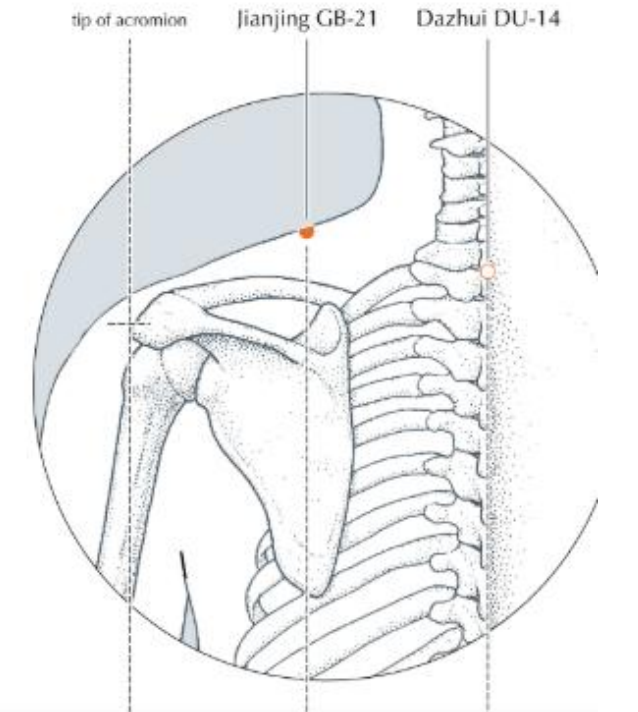
Deadman, P., et al. (2007) A manual of acupuncture. Sung In Printing America, Inc., Daly City.
Neck and shoulder tension is a familiar sensation for many people.
Have you ever had a stressful day and felt like you had a knot in your shoulder or neck that just seemed to come out of nowhere? Many people carry tension in their neck and shoulders. It’s not that we intentionally carry tension; our bodies just seem to carry tension in certain areas. Neck and shoulder tension and pain are some of the most common conditions that I treat as an acupuncturist. Although I treat many different conditions, there have been a good handful of times where the majority of patients I see in a day come in with neck and shoulder tension as their primary concern.
Often a major culprit of neck and shoulder tension is the trapezius muscle; a large muscle the spans from the mid-back, to the base of the skull, and to the shoulder blades. It gets its name because its shape resembles a trapezoid. The trapezius is responsible for many movements of the body including extension and rotation of the neck and movement of the shoulder blades (scapula) in various ways.
Have you ever felt that your shoulders shrug when you’re stressed? The trapezius muscle is the primary muscle that shrugs the shoulders.
There are a variety of causes of neck and shoulder tension and pain. Some causes include stress, post-workout soreness, magnesium deficiency, injury, poor posture, and poor sleep or lack of sleep. From an acupuncturists perspective we often view muscle tension or pain as a form of Qi (energy) and blood stagnation. In other words, we view it as an energy and blood circulation issue. There are various pathologies that could lead to energy and blood circulation issues and we as acupuncturists try to pinpoint patterns and causes before starting treatment.
You may ask, ‘what could acupuncture do for neck and shoulder tension or pain?’
I have found acupuncture to be very effective at treating neck and shoulder pain and tension. Sometimes even one treatment could bring people a lot of relief. In acupuncture, we use points that are both distal (distant from the center of the body) and local (near or at the area of concern) to treat many conditions. I personally like to use a combination of distal and local points. My favorite point for shoulder and neck tension is a point called Gallbladder 21. This point is located near the top of the trapezius muscle.
Typically, I squeeze the patient’s trapezius muscle to isolate the muscle and I needle the point Gallbladder 21. Often this point could cause a trigger point response where the muscle twitches due to a knot in the muscle releasing.
Often, this by itself could bring a lot of relief for people. Adding more points could often amplify the benefits.
I find acupuncture to be a very effective way of addressing neck and shoulder tension and pain. If you experience this issue and have yet to try acupuncture to address it, I would highly suggest that you give it a try. It may be best to inquire and book with an acupuncturist that specializes in sports acupuncture and musculoskeletal problems.
So, if your traps are tight or painful, remember that needles may actually help to reduce your pain and tension.